What Are Crayfish?
If you’ve ever flipped over a rock in a creek or explored the muddy bottom of a pond, there’s a good chance you’ve come face-to-face with one of nature’s most fascinating little creatures: the crayfish. Also known as crawdads or crawfish (depending on where you’re from), these freshwater crustaceans look like tiny lobsters—and honestly, they kind of act like them too.
But what are crayfish, really? They’re freshwater invertebrates in the crustacean family, closely related to lobsters, shrimp, and crabs. You’ll find them scuttling along creek beds, hiding under rocks, or even digging tunnels in the mud. They’ve got strong front claws for defense and food grabbing, and a flexible tail that helps them quickly dart backward to escape danger.
You’ll find over 500 species of crayfish around the world, but North America is home to the most—especially in places like the southern United States. These little guys aren’t just cool to look at—they’re an essential part of freshwater ecosystems.
Where Do Crayfish Live?
Crayfish thrive in freshwater environments like streams, creeks, rivers, lakes, and ponds. Some even live in underground burrows or in caves, depending on the species. I’ve personally seen crayfish hiding under slabs of limestone in Missouri creeks, staying tucked away in their little underwater hideouts until nightfall.
The most important thing for crayfish is clean, oxygen-rich water. That’s why their presence is often a sign of a healthy aquatic ecosystem. If a stream is full of pollution or gets too warm and stagnant, crayfish are usually one of the first critters to disappear.
They love areas with lots of cover—rocks, fallen branches, plant roots—anything that helps them feel safe and hidden from predators. Some crayfish even dig burrows in soft soil along the shoreline, complete with little chimneys made of mud balls stacked around the entrance. It’s like their version of a custom home!
A Closer Look at Crayfish Habitat
Crayfish don’t just live in the water—they interact with nearly every part of it. During the day, they’ll hide out in rock crevices, muddy tunnels, or submerged leaf piles, and at night, they come out to feed and explore.
In slower-moving streams and ponds, crayfish tend to gather in the shallow, vegetated zones. They use aquatic plants as both cover and a snack. In faster streams, they cling to rocks and nestle into gravel beds where the water brings in oxygen and food particles.
And when crayfish go underground in dry conditions, they can survive for months in a self-dug tunnel that reaches the water table. That’s how tough these little crustaceans are—they’ve adapted to wet and dry cycles better than most animals out there.
How Big Do Crayfish Get?
Most of the crayfish I’ve caught as a kid were about 3 to 5 inches long, but sizes vary depending on the species. The smallest species, like Cambarellus diminutus, can be under 1 inch long, while the largest—like Australia’s Astacopsis gouldi—can grow over 15 inches and weigh over 4 pounds!
North America’s most common species, like the red swamp crayfish, usually grow to about 4–5 inches, which is just big enough to make them look like miniature lobsters. It’s easy to see why folks in Louisiana toss them into big pots for a crawfish boil!
What Do Crayfish Eat?
Crayfish aren’t picky eaters. In fact, they’re opportunistic omnivores. That means they’ll eat just about anything they can get their claws on. Their diet includes plant matter, algae, insects, snails, fish eggs, and even other crayfish if they’re feeling aggressive or just super hungry.
What’s fascinating is how they use their claws and legs to manipulate food, almost like little hands. They pull food toward their mouths and chew with strong jaws called mandibles. If something is too big to eat, they’ll tear it into pieces first.
At night, you’ll see them crawling slowly along the bottom, scavenging for whatever’s left behind. They help clean up dead animals and leftover debris, which makes them key players in the health of freshwater systems.
Feeding Behavior and Water Filtering
One of the coolest things about crayfish is how they detect food in their environment. Instead of relying on sight, they use specialized fan-like appendages under their heads to push water past their antennae and mouthparts. This water carries chemical cues that help them sniff out food—even from several feet away!
It’s like they’ve got a built-in scent radar. Researchers have studied how crayfish actually manipulate the water flow around them to help bring in these chemical signals. So when a tasty insect dies and sinks to the bottom, a crayfish might “smell” it and follow the current until it finds dinner.
They’re like little vacuum cleaners with claws—and that’s one of the reasons you’ll always find them busy at night, working the creek bed like nature’s clean-up crew.
Crayfish Reproduction & Life Cycle
Crayfish reproduce sexually, and their mating season usually happens in the spring or fall depending on the species. Males will use special appendages called gonopods to transfer sperm to the female. After that, the female carries the fertilized eggs under her tail for weeks to months.
These eggs cling to the swimmerets (tiny limbs under the tail) and hatch into miniature crayfish—not larvae like insects, but fully-formed babies! Once they’re strong enough, they detach from mom and start their own independent lives.
Crayfish can live anywhere from 1 to 20 years, although 3–5 years is most typical in the wild. They go through multiple life stages and molt many times before reaching adulthood.
Molting: How Crayfish Grow
Because they have hard exoskeletons, crayfish can’t grow the way we do. Instead, they go through a process called molting, where they shed their outer shell to grow a new, larger one. It’s kind of like leaving behind an old suit of armor every few months.
Before molting, a crayfish will stop eating and find a safe hiding spot. Then, when the time comes, it splits its shell and backs out, leaving behind a perfect ghost of itself. The new shell underneath is soft at first, so the crayfish is super vulnerable to predators (or other hungry crayfish!) for a day or two.
What’s wild is that many crayfish will eat their old shell right after molting. Why? Because it’s full of calcium, which they need to harden their new shell.
Crayfish Behavior & Escape Reflex
Crayfish are mostly nocturnal, which means they’re most active at night. They’re solitary by nature and can be territorial, especially around molting time. If you’ve ever kept two crayfish in the same aquarium without enough hiding spots, you probably learned this the hard way.
One of their most fascinating behaviors is the “tail-flip” escape reaction—a super-fast movement where the crayfish curls its tail under and shoots backward in a sudden burst. It’s kind of like a reverse belly flop and helps them dodge predators in a split second.
That reflex is triggered by nerves that respond to vibration, touch, or sudden changes in water pressure. It’s one of the fastest escape responses in the animal kingdom!
Types & Diversity of Crayfish
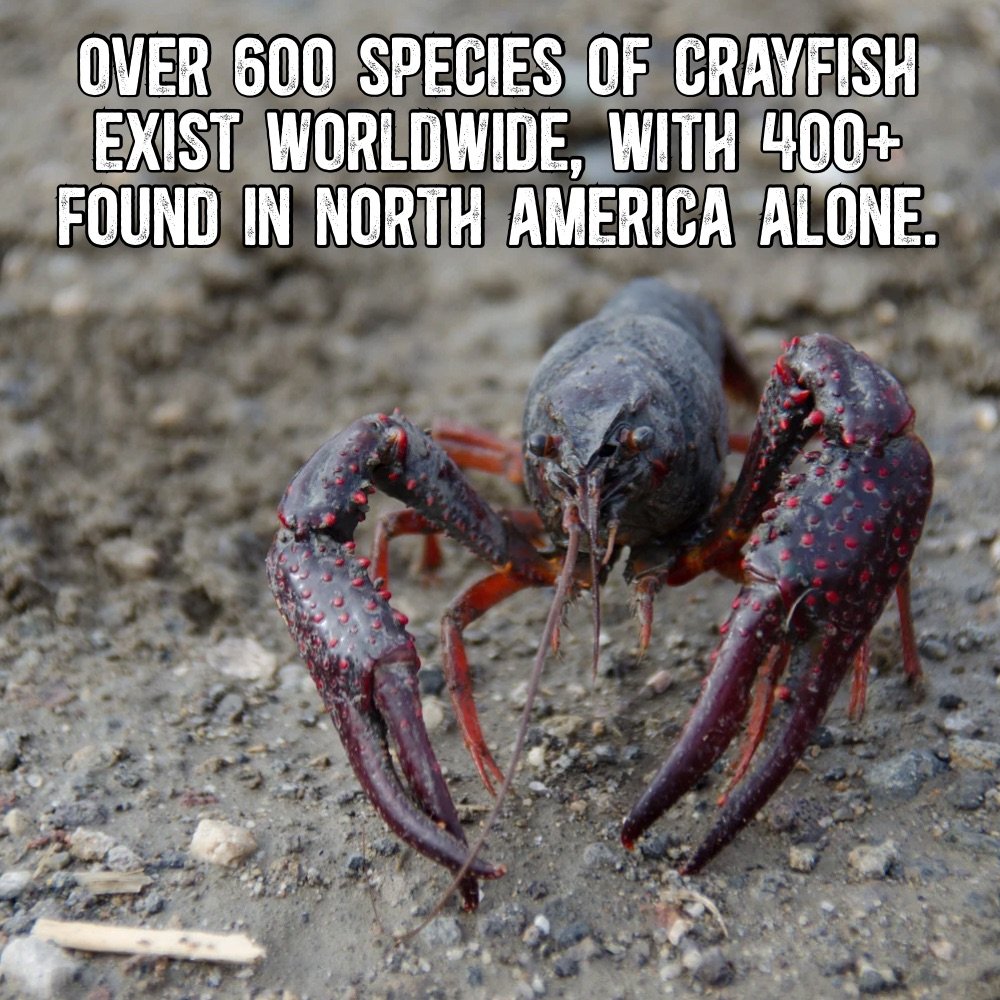
There are over 500 crayfish species, and they come in all sorts of shapes, sizes, and colors. The U.S. alone is home to more than 300 native species, many of which are found only in small, isolated areas.
Some of the most well-known species include:
- Red swamp crayfish – Common in Louisiana and used in cooking
- Northern crayfish – Widespread throughout the Midwest
- Signal crayfish – Introduced species that outcompete natives in Europe
- White river crayfish – Common in Arkansas and Missouri streams
- Dwarf crayfish – Tiny species perfect for aquariums
Their diversity makes them incredibly valuable to ecosystems and to researchers studying freshwater biodiversity.
Crayfish vs Lobsters: What’s the Difference?
A lot of people call crayfish “freshwater lobsters,” and while that’s not totally wrong, they’re definitely not the same animal. Yes, they’re both crustaceans. Yes, they both have claws. But they come from different families—lobsters from Nephropidae and crayfish from Cambaridae, Astacidae, or Parastacidae, depending on the region.
The biggest differences? Lobsters live in saltwater, grow much larger, and tend to be deeper-sea dwellers. Crayfish, on the other hand, are smaller, freshwater creatures and are more likely to be found under a rock in your local creek than crawling along the ocean floor.
Their diets are similar, and their body structures are close enough to confuse a casual observer—but when you put them side by side, the differences start to stand out quickly.
Natural Predators of Crayfish
Crayfish might look tough with their armored shells and powerful claws, but they’re actually prey for a wide variety of animals. Fish like bass, trout, and catfish love them. So do raccoons, birds, turtles, otters, and even snakes.
In fact, when crayfish come out at night, they risk becoming a midnight snack for almost anything larger and faster. That’s why they rely so heavily on stealth, shelter, and their quick escape reflex.
And yes—humans are a major predator too, especially in southern states like Louisiana, where crayfish are harvested by the millions each year. While that may seem sad, sustainable harvesting of crayfish is often less damaging to ecosystems than other types of freshwater fishing.
Crayfish in the Food Chain
Crayfish aren’t just survivors—they’re key players in the aquatic food chain. They help break down dead organic matter, which recycles nutrients back into the ecosystem. This benefits fish, amphibians, insects, and even plants.
At the same time, they’re an important food source for larger animals. That dual role makes crayfish what biologists call a “keystone species”—they influence the entire structure of their environment.
If crayfish disappear from a stream, you’ll quickly notice ripple effects throughout the food web. That’s why protecting their habitats is such a big deal in conservation work.
Crayfish and Water Quality
Here’s something that surprised me when I first learned it: crayfish can actually help monitor water quality. Because they’re sensitive to pollution, scientists sometimes use them as bioindicators in rivers and streams.
If a waterway is full of healthy, active crayfish, that’s usually a good sign. But if they start dying off or acting strangely, it could mean there’s a problem—like chemicals, low oxygen levels, or high water temperatures.
They’re kind of like tiny, armored canaries in the coal mine. Their presence tells us more than just “the creek looks clean”—it confirms that the ecosystem is working the way it’s supposed to.
Crayfish Communication
Crayfish don’t have voices, but they sure do “talk” in their own way. They use a mix of chemical signals, posture, and physical interaction to communicate with each other.
For example, during territorial disputes, two crayfish will raise their claws, whip their antennae, and face off like sumo wrestlers. Sometimes one backs down without a fight, but if not—they clash, using their claws to push and wrestle until one gives up.
Chemical cues in the water also help them identify mates or rivals, and sometimes even signal whether another crayfish has recently molted and is vulnerable. It’s a surprisingly complex social system for something without a brain like ours.
Crayfish Burrowing Behavior
Certain species of crayfish are expert burrowers—they dig deep tunnels into muddy banks or grassy wetlands. Some of these burrows can go several feet down, often reaching the groundwater.
Burrowing crayfish are amazing at surviving dry spells, since they stay moist and cool underground. These burrows often have chimney-like openings, made from little mud balls stacked at the entrance. I’ve come across these a bunch on hiking trails near streams—they look like tiny mud volcanoes!
Some species even spend most of their lives underground, only coming out after rains or at night to forage. It’s just another way crayfish have adapted to thrive in wildly different environments.
Crayfish in Home Aquariums
Believe it or not, crayfish make interesting pets, especially for people who love aquatic life. But they’re not for beginners—they require space, hiding spots, and clean, oxygenated water.
Crayfish are notorious for being aggressive and territorial, especially if kept with other crayfish or slow-moving fish. I’ve had one in a tank before that literally tried to rearrange the gravel every night and would attack anything that got too close to its rock cave.
That said, species like the dwarf orange crayfish are calmer and smaller, making them more aquarium-friendly. Just be sure you’ve got a secure tank lid—because yes, they will try to escape!
Crayfish in Culture and Cuisine
In the southern United States, especially Louisiana, crayfish are more than just a critter—they’re a cultural icon. Every spring, folks gather for massive crawfish boils, where dozens of pounds of crayfish are boiled with corn, potatoes, and spices. It’s a social event as much as it is a meal.
But it’s not just the U.S. Crayfish are eaten in Sweden, China, Nigeria, and Australia, often prepared in soups, stews, or grilled with seasoning. In some places, crayfish are even associated with local festivals or folk traditions.
Beyond food, crayfish have shown up in folklore and art as symbols of resourcefulness and survival. Not bad for a mud-crawling invertebrate!
Threats to Crayfish Populations
Unfortunately, crayfish aren’t immune to modern problems. Some of the biggest threats they face include:
- Pollution – Runoff from farms, factories, or urban areas poisons their habitat
- Invasive species – Like the rusty crayfish, which outcompete natives
- Habitat loss – Due to stream channeling, urban development, or damming
- Climate change – Altering water temperatures and oxygen levels
Several crayfish species are now considered endangered, and conservationists are working hard to monitor populations and protect their homes.
Why Crayfish Matter
So, why should we care about crayfish? It’s simple: they keep freshwater ecosystems balanced, they’re a vital part of the food web, and they even help scientists track environmental changes.
Whether you’re a biology nerd, an angler, a kid with a net, or someone who just loves watching nature do its thing—crayfish deserve our attention and respect.
These little guys may be small, but their impact is massive. Next time you spot one creeping under a rock or building a mud chimney, stop and appreciate just how cool they really are.